The handbook
Cover, scope and price. Buying takes only an e-mail address.
Handbooks · Volume 4
Secure without an IT department
Passwords, backups, access, emergencies: the four basics insurers and audit checklists ask small businesses about, and how to tell they are done.
- 16 sections in 4 parts, the last part is the appendix with 4 sections
- Online reading access via your personal link
- Full handbook as a PDF
€39.00incl. VAT. One-off payment, no subscription.
Free to read: Purpose and structure, Contents, Why basic protection comes before AI.
The contents
16 sections in 4 parts, the last part is the appendix with 4 sections. Free to read: Purpose and structure, Contents, Why basic protection comes before AI.
Part I · Sections 1 – 3
What this is about
- 03Why basic protection comes before AI
- 04What audit checklists ask — and why they resemble one another
- 05What is an obligation and what is a recommendation
Part II · Sections 4 – 9
The four things to get right
- 06Access I: passwords and the password manager
- 07Access II: second factor, administrative rights, who leaves
- 08Backups: what, where, how often — and the one test almost nobody does
- 09Devices and updates
- 10E-mail and fraud
- 11Responsibility, rules, training
Part III · Sections 10 – 12
When it happens, and who helps
- 12The emergency: the first hour and the first day
- 13Reporting channels and points of contact
- 14Contractors: what you may demand of an IT provider
Part IV · Sections 13 – 16
Appendix
- 15Self-assessment
- 16Uncertainties
- 17Glossary
- 18List of sources
Sample
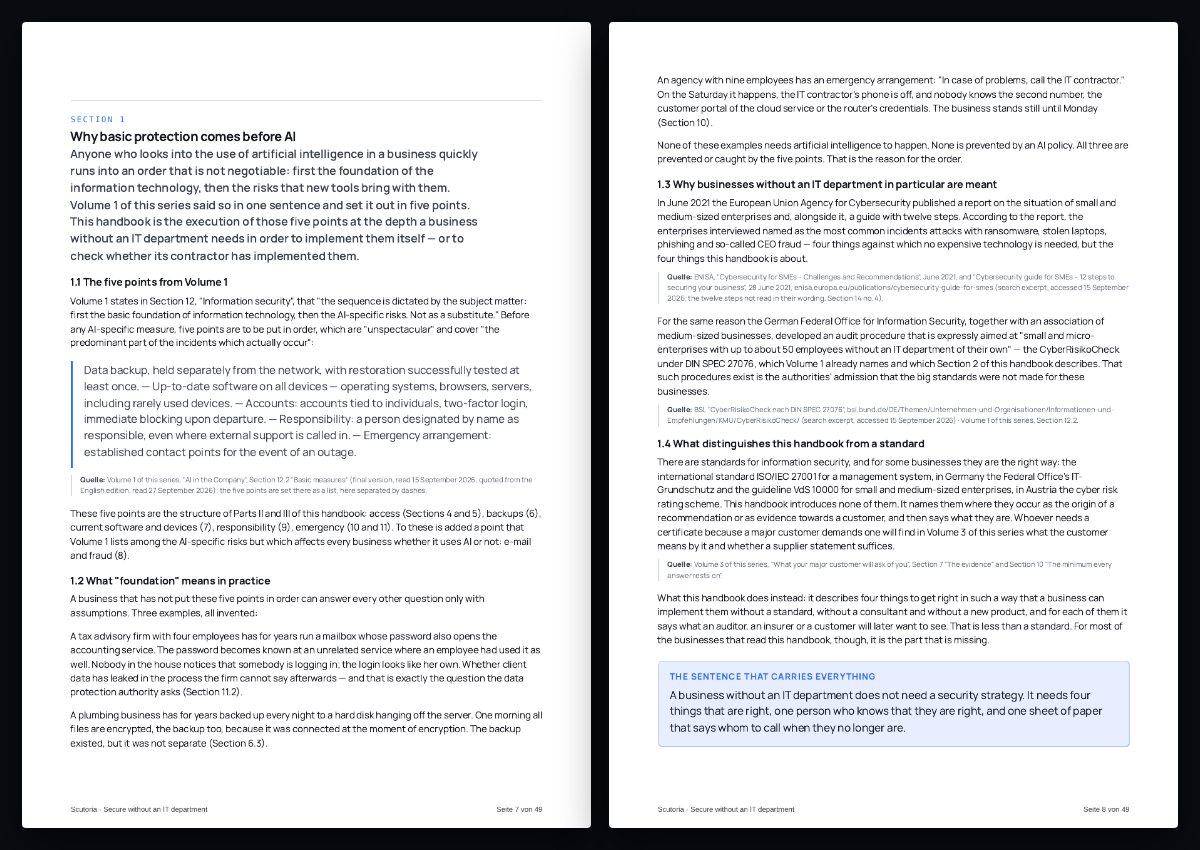
The beginning of Section 1, unchanged from the handbook. The source lines are in the reading sample.
Why basic protection comes before AI
Anyone who looks into the use of artificial intelligence in a business quickly runs into an order that is not negotiable: first the foundation of the information technology, then the risks that new tools bring with them. Volume 1 of this series said so in one sentence and set it out in five points. This handbook is the execution of those five points at the depth a business without an IT department needs in order to implement them itself — or to check whether its contractor has implemented them.
Volume 1 states in Section 12, "Information security", that "the sequence is dictated by the subject matter: first the basic foundation of information technology, then the AI-specific risks. Not as a substitute." Before any AI-specific measure, five points are to be put in order, which are "unspectacular" and cover "the predominant part of the incidents which actually occur":
Data backup, held separately from the network, with restoration successfully tested at least once. — Up-to-date software on all devices — operating systems, browsers, servers, including rarely used devices. — Accounts: accounts tied to individuals, two-factor login, immediate blocking upon departure. — Responsibility: a person designated by name as responsible, even where external support is called in. — Emergency arrangement: established contact points for the event of an outage.
These five points are the structure of Parts II and III of this handbook: access (Sections 4 and 5), backups (6), current software and devices (7), responsibility (9), emergency (10 and 11). To these is added a point that Volume 1 lists among the AI-specific risks but which affects every business whether it uses AI or not: e-mail and fraud (8).
Newsletter and more
Keep up, and titles that go with this volume.
Goes with it