The handbook
Cover, scope and price. Buying takes only an e-mail address.
Practical guides · Practical guide
Setting up Claude in your business
The account, access, the settings to check first, one real piece of work from start to finish, and the list of what never goes in.
- 12 sections in 4 parts, the last part is the appendix with 4 sections
- Online reading access via your personal link
- Full handbook as a PDF
€39.00incl. VAT. One-off payment, no subscription.
Free to read: Purpose and structure, Contents, Before you begin.
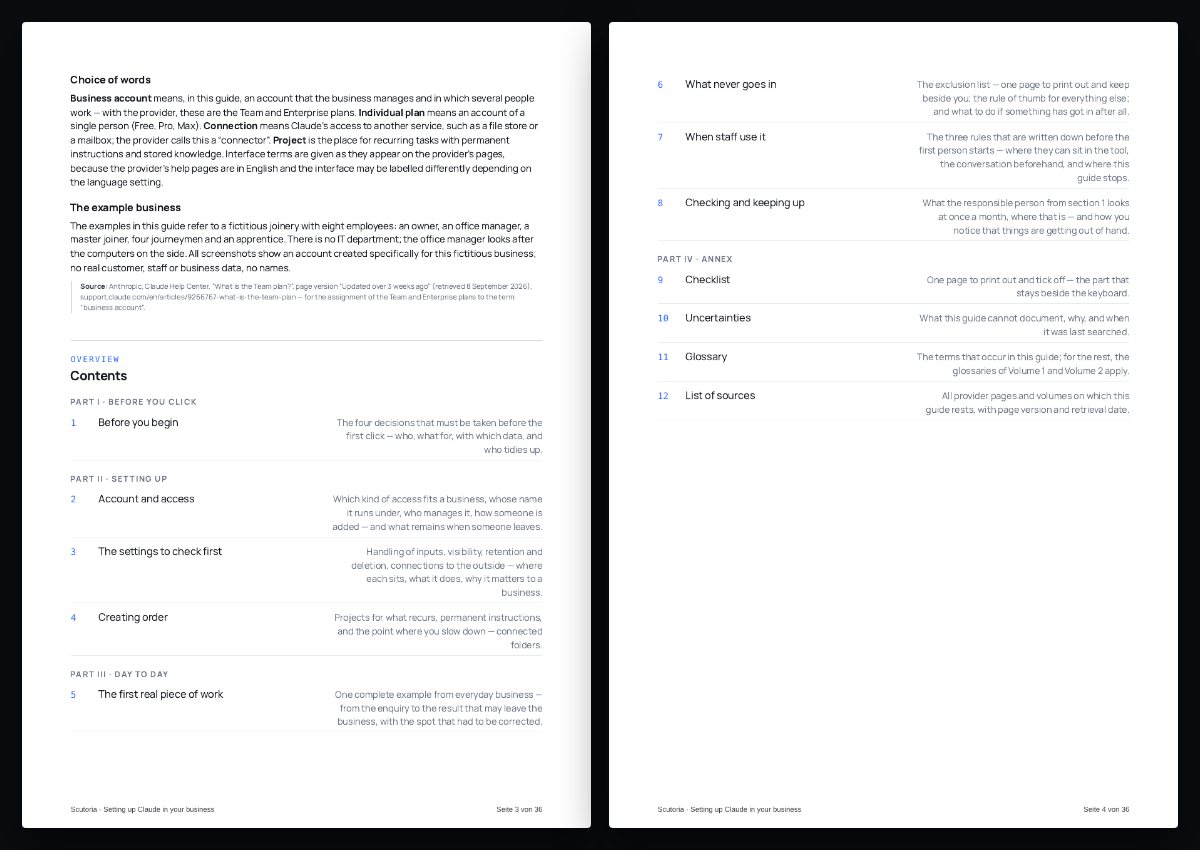
The contents
12 sections in 4 parts, the last part is the appendix with 4 sections. Free to read: Purpose and structure, Contents, Before you begin.
Part II · Sections 2 – 4
Setting up
- 04Account and access
- 05The settings to check first
- 06Creating order
Part III · Sections 5 – 8
Day to day
- 07The first real piece of work
- 08What never goes in
- 09When staff use it
- 10Checking and keeping up
Part IV · Sections 9 – 12
Annex
- 11Checklist
- 12Uncertainties
- 13Glossary
- 14List of sources
Sample
The beginning of Section 1, unchanged from the handbook. The source lines are in the reading sample.
Before you begin
Most businesses create an account first and think afterwards about who may use it. That is the wrong order, and you only notice when the first file ends up in the wrong place. Four decisions belong beforehand. Together they take twenty minutes and save you the clean-up.
Not “everyone” and not “just me, let's see”. Write down two or three positions: the office manager and me. The reason is practical: every further access is one more place where something can get in that does not belong — and one more person you have to see off when they leave.
This decision determines the kind of account, and it does so already here. An individual plan is an account for exactly one person: for the individual plans the provider lists project sharing and collaboration, central billing and administration and role-based access as No. A business account starts at two people. So anyone who wants to work as a pair does not choose between “an account” and “a bigger account”, but between two separate individual accounts without shared administration and a business account. Section 2 sets this out.
Whoever starts small can expand. Whoever starts wide has to gather everything back in.
Newsletter and more
Keep up, and titles that go with this volume.
Goes with it