Security · Business · AI
Security, business and technology belong together. Those who think of them together lead their business into the future.
For businesses without an IT department: Scutoria makes information security, compliance and the use of AI understandable and workable. Handbooks, practical guides, templates and online tools for those who have to decide.
Source-based · no legal advice
- SecurityProtection that works day to day: understandable, workable, demonstrable.
- BusinessSecurity as an advantage in competition: what it costs, what it brings, what comes first.
- AIUsing new technology without putting data, reputation and legal certainty at risk.
Products
Three lines, every title. What there is and what it costs, at a glance.
All titles · 10 10 titles: 4 Handbooks, 3 Practical guides, 3 Templates and kits. Swipe or click: the chosen title moves to the centre.
Volume 1
AI in the Company
The handbook for company management: the basics, introducing AI in the business, the legal and standards framework.
19 sections in 4 parts · about 1.5 hours of reading
Table of contents
- Part I · Sections 1 – 3 · Fundamentals
- The term and its delimitation
- Providers, tools and costs
- Capability, limits and rights in the output
- Part II · Sections 4 – 7 · Introducing AI in the company
- Fields of application by functional area
- Stages of technical integration
- Procedure for introduction
- Internal rules and training
- Part III · Sections 8 – 14 · Legal and standards framework
- Roles and responsibilities
- Scope and time limits of the AI Act
- Transparency obligations
- Data protection
- Information security
- International standards and frameworks
- Supervision and penalties
- Part IV · Sections 15 – 19 · Appendix
- Maturity self-assessment
- Statements not made
- Open questions
- Glossary
- List of sources
€49.00To the book ›
Handbooks · A2
AI Policies for the Workforce
Rules for your own people: what may go in, what never, who approves, who trains. The counterpart to the policy kit — the volume gives the reasoning, the kit supplies the templates.
15 sections in 4 parts · about 1.5 hours of reading
Table of contents
- Part I · Sections 1 – 3 · Why have rules at all
- What a set of rules can achieve and what it cannot
- The situation without rules
- What the law and the authorities require — and what they do not
- Part II · Sections 4 – 6 · The decisions that come before the writing
- Who may, for what, with which data, and who approves
- Approval of new tools
- Access, accounts and default settings
- Part III · Sections 7 – 10 · The rules themselves
- What belongs in them, subject by subject
- Training, instruction and evidence
- Bringing into force and keeping current
- When someone breaches them
- Part IV · Sections 11 – 15 · Annex
- Self-assessment of the state of the rules
- Statements not made
- Open questions
- Glossary
- List of sources
€39.00To the title ›
Handbooks · A3
What your major customer will ask of you
For businesses that are not covered themselves and get the requirement anyway — through their customer's purchasing department. What gets asked, what counts as a usable answer, and what to write down beforehand.
16 sections in 4 parts · about 2.5 hours of reading
Table of contents
- Part I · Sections 1 – 4 · Why you are being asked
- Three laws, one mechanism
- Whether you are covered yourself — a signpost
- If your customer is a financial entity
- If your customer manufactures products with digital elements
- Part II · Sections 5 – 8 · What is asked
- The questionnaire: fourteen recurring topics
- The contract clauses: eight under the Implementing Regulation, nine plus six under DORA
- The evidence: what is asked for, what a small company can provide
- Your customer's registers
- Part III · Sections 9 – 12 · What a usable answer is, and what you write down beforehand
- Three levels of answer
- The minimum every answer rests on
- Training, staff, subcontractors, locations, termination
- What is negotiable — and when "not applicable" is the right answer
- Part IV · Sections 13 – 16 · Appendix
- Self-assessment
- Uncertainties
- Glossary
- List of sources
€49.00To the title ›
Handbooks · A5
Secure without an IT department
Passwords, backups, access, emergencies — in the order and depth that insurers and audit checklists ask of small businesses. The foundation without which everything else stands on sand.
16 sections in 4 parts · about 2 hours of reading
Table of contents
- Part I · Sections 1 – 3 · What this is about
- Why basic protection comes before AI
- What audit checklists ask — and why they resemble one another
- What is an obligation and what is a recommendation
- Part II · Sections 4 – 9 · The four things to get right
- Access I: passwords and the password manager
- Access II: second factor, administrative rights, who leaves
- Backups: what, where, how often — and the one test almost nobody does
- Devices and updates
- E-mail and fraud
- Responsibility, rules, training
- Part III · Sections 10 – 12 · When it happens, and who helps
- The emergency: the first hour and the first day
- Reporting channels and points of contact
- Contractors: what you may demand of an IT provider
- Part IV · Sections 13 – 16 · Appendix
- Self-assessment
- Uncertainties
- Glossary
- List of sources
€39.00To the title ›
Practical guides · B1
Setting up Claude in your business
Step by step with screenshots: the account, access, the settings to check first, one real piece of work from start to finish — and the list of what never goes in.
12 sections in 4 parts · about 1 hours of reading
Table of contents
- Part I · Section 1 · Before you click
- Before you begin
- Part II · Sections 2 – 4 · Setting up
- Account and access
- The settings to check first
- Creating order
- Part III · Sections 5 – 8 · Day to day
- The first real piece of work
- What never goes in
- When staff use it
- Checking and keeping up
- Part IV · Sections 9 – 12 · Annex
- Checklist
- Uncertainties
- Glossary
- List of sources
€39.00To the title ›
Practical guides · B2
Setting up ChatGPT in your business
The same route for the second widely used tool: business account, use of your data, sharing, filing.
12 sections in 4 parts · about 1.5 hours of reading
Table of contents
- Part I · Sections 1 – 2 · Deciding and setting up
- Before you begin
- Account and access
- Part II · Sections 3 – 5 · Settings and order
- The settings to check first
- Creating order
- The first real job
- Part III · Sections 6 – 8 · Rules and follow-up
- What never goes in
- When employees use it
- Checking and following up
- Part IV · Sections 9 – 12 · Appendix
- Checklist
- Uncertainties
- Glossary
- List of sources
€39.00To the title ›
Practical guides · B5
Setting up Microsoft 365 Copilot in your business
Configure Copilot in Word, Outlook and Teams so the assistant only sees what it is allowed to see: permissions, filing, sharing. Step by step with screenshots.
12 sections in 4 parts · about 1.5 hours of reading
Table of contents
- Part I · Section 1 · Before you click
- Before you begin
- Part II · Sections 2 – 4 · Setting up
- Licence, roles and access
- The settings to check first
- Filing and sharing: what Copilot sees
- Part III · Sections 5 – 9 · Using and keeping track
- The first real working run
- What never goes in
- When staff use it
- Checking and keeping track
- Checklist
- Part IV · Sections 10 – 12 · Appendix
- Uncertainties
- Glossary
- List of sources
€49.00To the title ›
Templates and kits · C1
AI evidence kit
Usage policy, tool register, training record and labelling checklist — ready to fill in, so a business can show what it has regulated and who has been trained.
9 sections in 3 parts · about 53 minutes of reading
Table of contents
- Part I · Sections 1 – 5 · The five records
- The usage policy and the one-page summary
- The tool register and the approval form
- The training record
- The labelling checklist
- Entry into force
- Part II · Section 6 · Context
- The difference from the Economic Chamber's free template
- Part III · Sections 7 – 9 · Annex
- Uncertainties
- Glossary
- Sources
€69.00To the title ›
Templates and kits · C4
Supplier questionnaire response kit
Model answers, self-disclosure, evidence folder and clause checklist for the security questionnaires large customers send. For the moment when the questionnaire is in your inbox and the deadline is running.
11 sections in 4 parts · about 1 hours of reading
Table of contents
- Part I · Section 1 · Before you answer
- Why you are being asked, and how to answer
- Part II · Sections 2 – 7 · The six files, in the order of filling them in
- Write down first
- The question catalogue
- The self-disclosure
- The evidence list
- The cover letter
- The clause checklist
- Part III · Section 8 · Afterwards
- When the customer asks follow-up questions
- Part IV · Sections 9 – 11 · Appendix
- Uncertainties
- Glossary
- List of sources
€69.00To the title ›
Templates and kits · C6
AI evidence kit: law firm, tax advisory, medical practice
The evidence kit with what is specific to law firms, tax advisors and medical practices: confidentiality, client and patient data, what the assistant must never see there. Complements the kit, replaces no legal advice.
10 sections in 3 parts · about 1.5 hours of reading
Table of contents
- Part I · Section 1 · What is different in the three professions
- Professional secrecy and confidentiality — what the kit records and what it does not
- Part II · Sections 2 – 7 · The records
- The usage policy and the supplement sheets
- What never goes in here — the three pages
- The tool register and the approval form with the special types of data
- The training record — auxiliary persons and confidentiality declaration
- The labelling checklist for external effect
- The chamber checklist and the entry into force
- Part III · Sections 8 – 10 · Annex
- Uncertainties
- Glossary
- Sources
€79.00To the title ›
To the shop › Free Eight tools, no sign-up: what suits your business, whether a text belongs in there, whether NIS2 applies to you.
AI in the Company
The main product. Four questions, one page, five fields of action and the contents: in one card, with tabs.
The main product · Volume 1
Buy now · €49.00Read the sample
Available immediately. Access directly after payment. PDF and online access, invoice by email.
Four questions, in this order. That is how the first page of the handbook puts it.
-
What does the term “artificial intelligence” denote, and which tools are available?
Clarification of the term, a market overview and a sober assessment of what the technology delivers and what it does not.
How the handbook answers it, Part I „Fundamentals“ · 2 sections
- 03 The term and its delimitation read for free
- 04 Providers, tools and costs
-
What operational benefit can they provide, and where do their limits lie?
Clarification of the term, a market overview and a sober assessment of what the technology delivers and what it does not.
How the handbook answers it, Part I „Fundamentals“ · 2 sections
- 05 Capability, limits and rights in the output
- 06 Fields of application by functional area
-
By what routes can they be integrated into an existing business?
Fields of application, stages of technical integration, a procedure for introduction and the internal rules required.
How the handbook answers it, Part II „Introducing AI in the company“ · 3 sections
- 07 Stages of technical integration
- 08 Procedure for introduction
- 09 Internal rules and training
-
Which legal and normative requirements are to be observed in doing so?
Allocation of roles, scope and time limits of the AI Act, marking, data protection, information security, international standards as well as supervision and penalties.
How the handbook answers it, Part III „Legal and standards framework“ · 7 sections
- 10 Roles and responsibilities
- 11 Scope and time limits of the AI Act
- 12 Transparency obligations
- 13 Data protection
- 14 Information security
- 15 International standards and frameworks
- 16 Supervision and penalties
Understand first, then deploy, then secure. The law comes last, but it comes — with date and reference. Under each question the sections that set it out.
Section 1 is open, without sign-up and without buying.Read Section 1
Which volume
The term and its delimitation
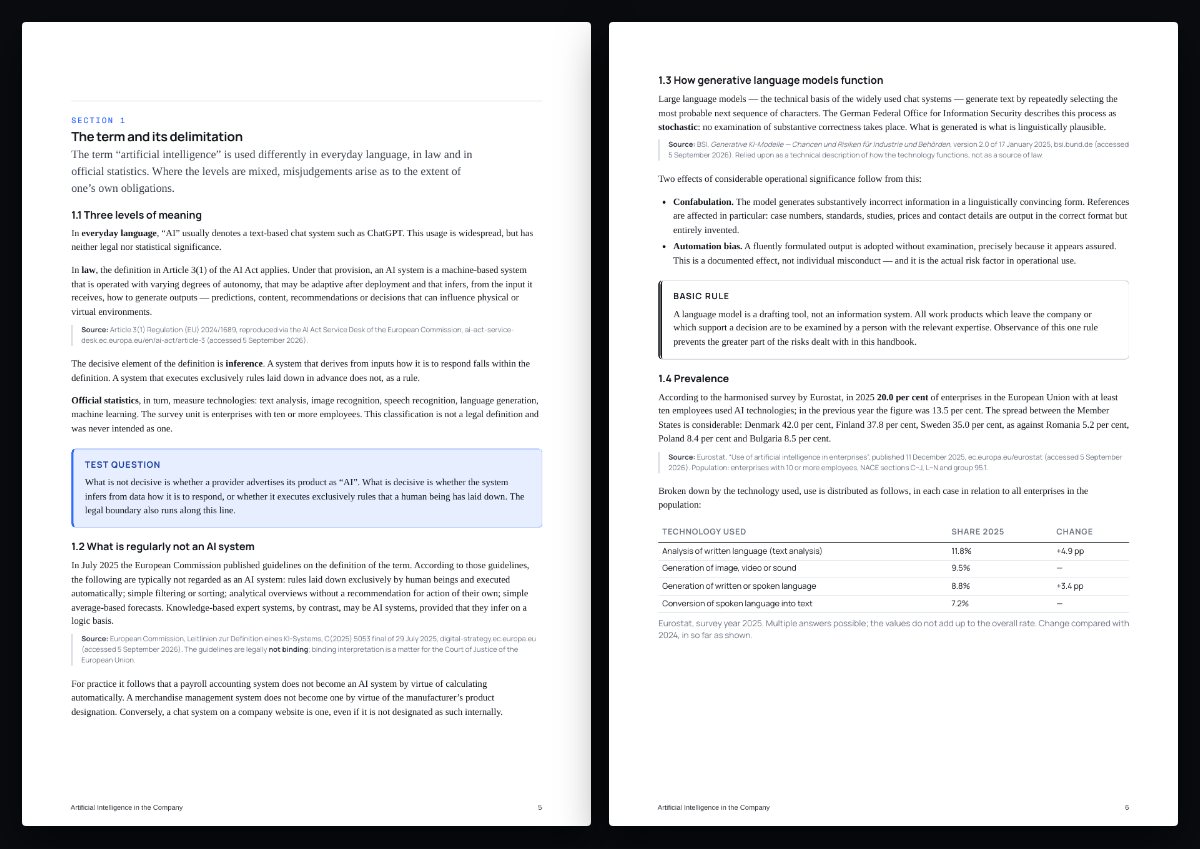
The term “artificial intelligence” is used differently in everyday language, in law and in official statistics. Where the levels are mixed, misjudgements arise as to the extent of one’s own obligations.
In everyday language, “AI” usually denotes a text-based chat system such as ChatGPT. This usage is widespread, but has neither legal nor statistical significance.
In law, the definition in Article 3(1) of the AI Act applies. Under that provision, an AI system is a machine-based system that is operated with varying degrees of autonomy, that may be adaptive after deployment and that infers, from the input it receives, how to generate outputs — predictions, content, recommendations or decisions that can influence physical or virtual environments.
The decisive element of the definition is inference. A system that derives from inputs how it is to respond falls within the definition. A system that executes exclusively rules laid down in advance does not, as a rule.
Official statistics, in turn, measure technologies: text analysis, image recognition, speech recognition, language generation, machine learning. The survey unit is enterprises with ten or more employees. This classification is not a legal definition and was never intended as one.
What a set of rules can achieve and what it cannot
A set of usage rules does not change what an AI tool can do. It changes who uses it for what, which information goes into it, and who bears the consequences.
It makes visible what is happening anyway. The German data protection supervisory authorities describe the starting position unusually directly: without clear rules there is a risk that employees will use AI applications “on their own initiative and without control”, and it must be assumed that this is “currently the reality in many companies and public bodies”. Rules that name the tools provided by the company and open up reporting channels bring that use out of the invisible.
It moves decisions to where they belong. Without rules, each member of staff decides case by case whether a customer’s address may go into an external system. With rules, the company decides that — once, in advance, and the same way for everyone. The Austrian Economic Chamber puts the same thought in terms of tool selection: it is for company management alone to decide whether an application is permissible.
It can itself be a protective measure to which legal consequences attach. Under Union law, information is a trade secret only if, among other things, “it has been subject to reasonable steps under the circumstances, by the person lawfully in control of the information, to keep it secret”. Protection therefore depends on an act of the holder, not on the value of the information alone.
Written rules that are made known and enforced, governing what may be entered into external services, are in substance such a step. No court decision was found that expressly brings a set of AI usage rules under that point, or that treats their absence as causing the loss of trade secret protection. The connection therefore remains a question each company must answer for itself, and not an established legal consequence (Section 13).
Three laws, one mechanism
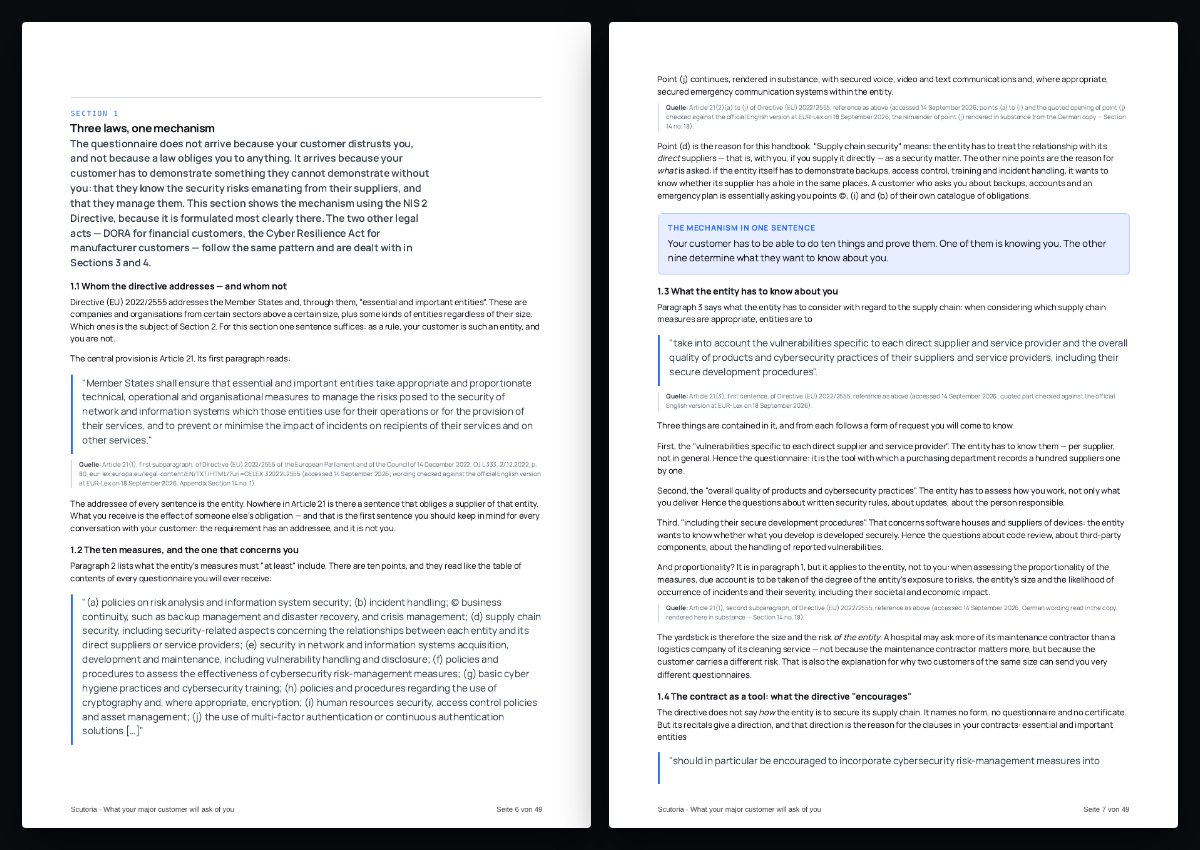
The questionnaire does not arrive because your customer distrusts you, and not because a law obliges you to anything. It arrives because your customer has to demonstrate something they cannot demonstrate without you: that they know the security risks emanating from their suppliers, and that they manage them. This section shows the mechanism using the NIS 2 Directive, because it is formulated most clearly there. The two other legal acts — DORA for financial customers, the Cyber Resilience Act for manufacturer customers — follow the same pattern and are dealt with in Sections 3 and 4.
Directive (EU) 2022/2555 addresses the Member States and, through them, "essential and important entities". These are companies and organisations from certain sectors above a certain size, plus some kinds of entities regardless of their size. Which ones is the subject of Section 2. For this section one sentence suffices: as a rule, your customer is such an entity, and you are not.
The central provision is Article 21. Its first paragraph reads:
"Member States shall ensure that essential and important entities take appropriate and proportionate technical, operational and organisational measures to manage the risks posed to the security of network and information systems which those entities use for their operations or for the provision of their services, and to prevent or minimise the impact of incidents on recipients of their services and on other services."
The addressee of every sentence is the entity. Nowhere in Article 21 is there a sentence that obliges a supplier of that entity. What you receive is the effect of someone else's obligation — and that is the first sentence you should keep in mind for every conversation with your customer: the requirement has an addressee, and it is not you.
Why basic protection comes before AI
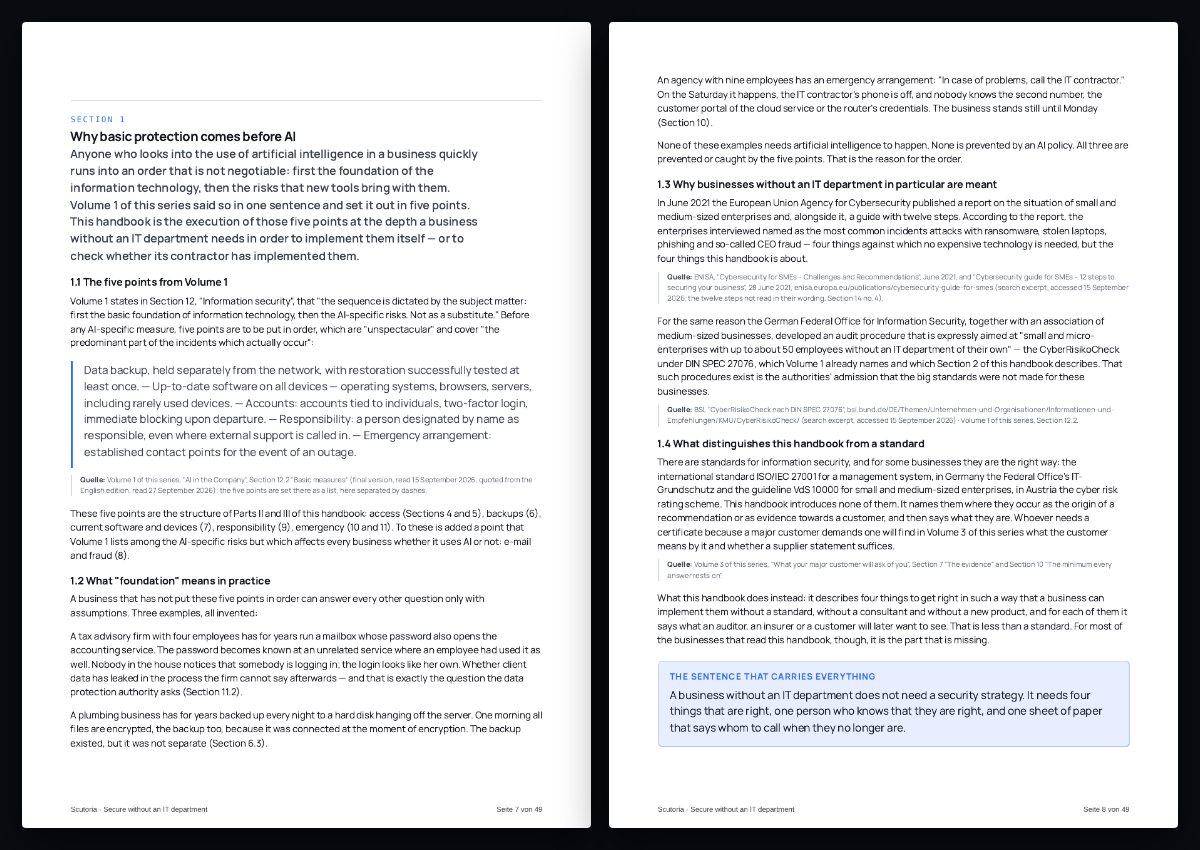
Anyone who looks into the use of artificial intelligence in a business quickly runs into an order that is not negotiable: first the foundation of the information technology, then the risks that new tools bring with them. Volume 1 of this series said so in one sentence and set it out in five points. This handbook is the execution of those five points at the depth a business without an IT department needs in order to implement them itself — or to check whether its contractor has implemented them.
Volume 1 states in Section 12, "Information security", that "the sequence is dictated by the subject matter: first the basic foundation of information technology, then the AI-specific risks. Not as a substitute." Before any AI-specific measure, five points are to be put in order, which are "unspectacular" and cover "the predominant part of the incidents which actually occur":
Data backup, held separately from the network, with restoration successfully tested at least once. — Up-to-date software on all devices — operating systems, browsers, servers, including rarely used devices. — Accounts: accounts tied to individuals, two-factor login, immediate blocking upon departure. — Responsibility: a person designated by name as responsible, even where external support is called in. — Emergency arrangement: established contact points for the event of an outage.
These five points are the structure of Parts II and III of this handbook: access (Sections 4 and 5), backups (6), current software and devices (7), responsibility (9), emergency (10 and 11). To these is added a point that Volume 1 lists among the AI-specific risks but which affects every business whether it uses AI or not: e-mail and fraud (8).
Read it as it is written. The beginning of Section 1, unchanged from the handbook. No jargon, no legal provisions on page one. Every figure and every legal statement in the book carries a source and date accessed. You see the source lines in the sample.
The whole beginning, with the source lines, as it stands in the book.Read Section 1 in full
The statements appear in this form in the handbook, in the appendix “Selbstbewertung”, with the rating scale, the evaluation and the measures derived from it. The index shows which sections belong to them.
Where does my business stand on AI? The self-assessment from the handbook: five fields of action, one profile.Start the quick check
19 sections in 4 parts, the last part is the appendix with 5 sections.
Part I Fundamentals
- 03The term and its delimitationfree
- 04Providers, tools and costs
- 05Capability, limits and rights in the output
Part II Introducing AI in the company
- 06Fields of application by functional area
- 07Stages of technical integration
- 08Procedure for introduction
- 09Internal rules and training
Part III Legal and standards framework
- 10Roles and responsibilities
- 11Scope and time limits of the AI Act
- 12Transparency obligations
- 13Data protection
- 14Information security
- 15International standards and frameworks
- 16Supervision and penalties
Part IV Appendix
- 17Maturity self-assessment
- 18Statements not made
- 19Open questions
- 20Glossary
- 21List of sources
Tools
Eight tools free of charge and without signing in, nine more with Premium. Two minutes in the browser, before you read the book, or after.
What suits my business?
Six questions, then a suggestion where to start.
2 min · freeStart the check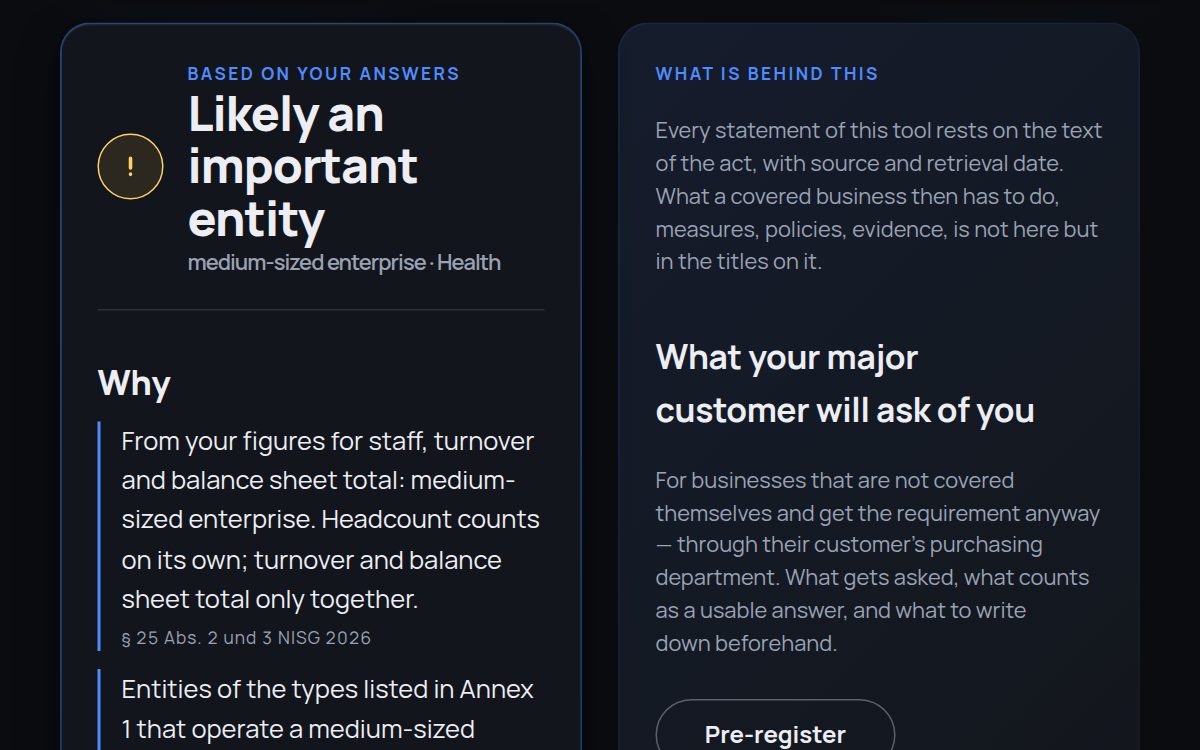
Does my business fall under NIS2?
Ten questions, then a classification under the Austrian NISG 2026, with a source under every statement.
3 min · freeStart the check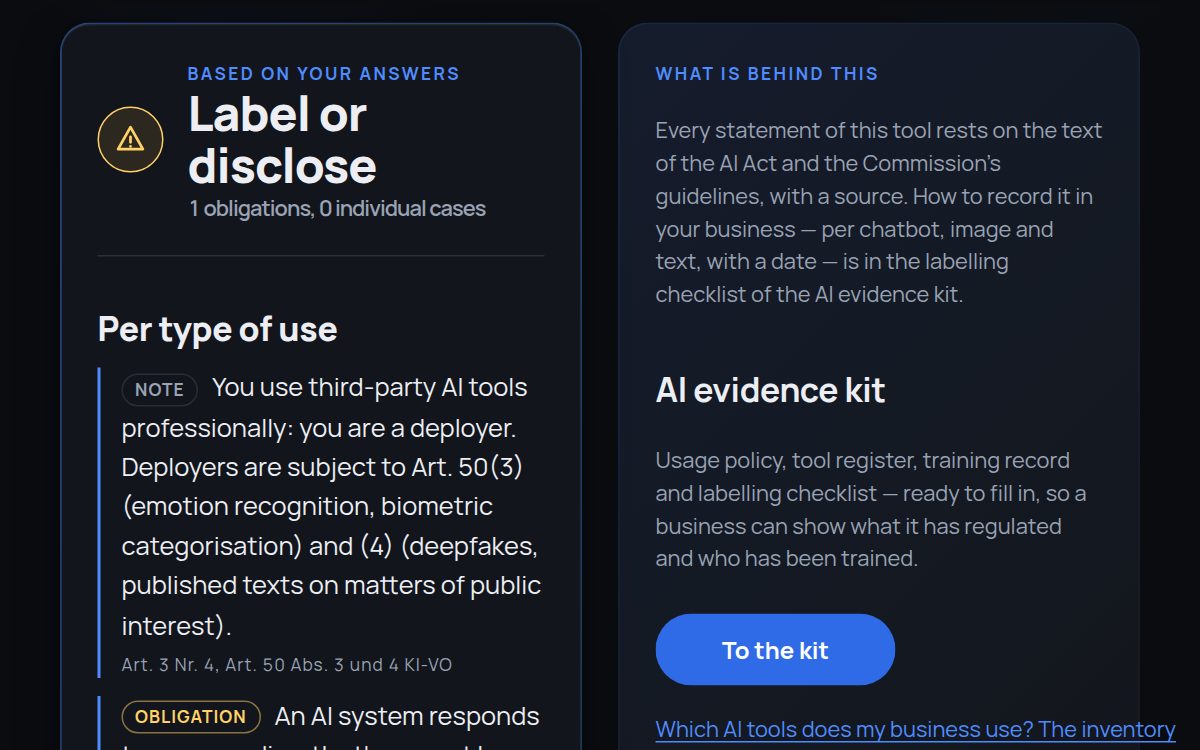
Do I have to label this?
Six questions on chatbots, images and texts, then a classification under Art. 50 AI Act with sources.
3 min · freeStart the check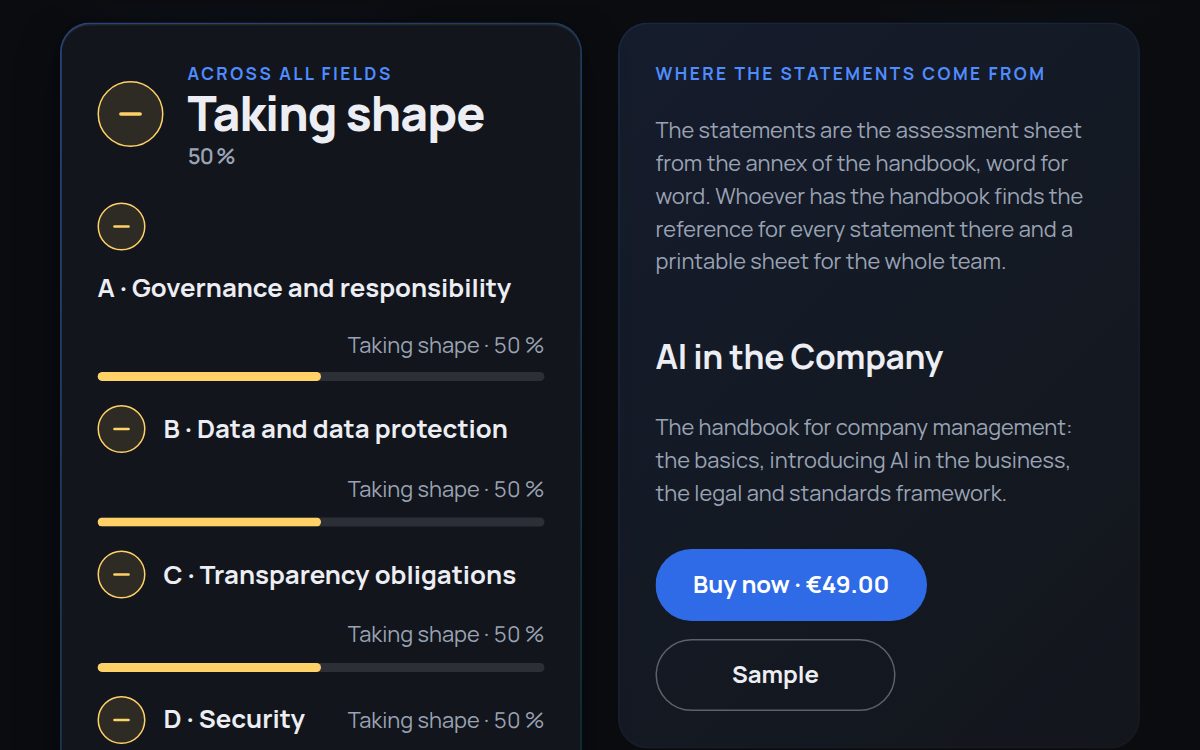
Where does my business stand on AI?
The self-assessment from the handbook: five fields of action, one profile.
5 min · freeStart the quick check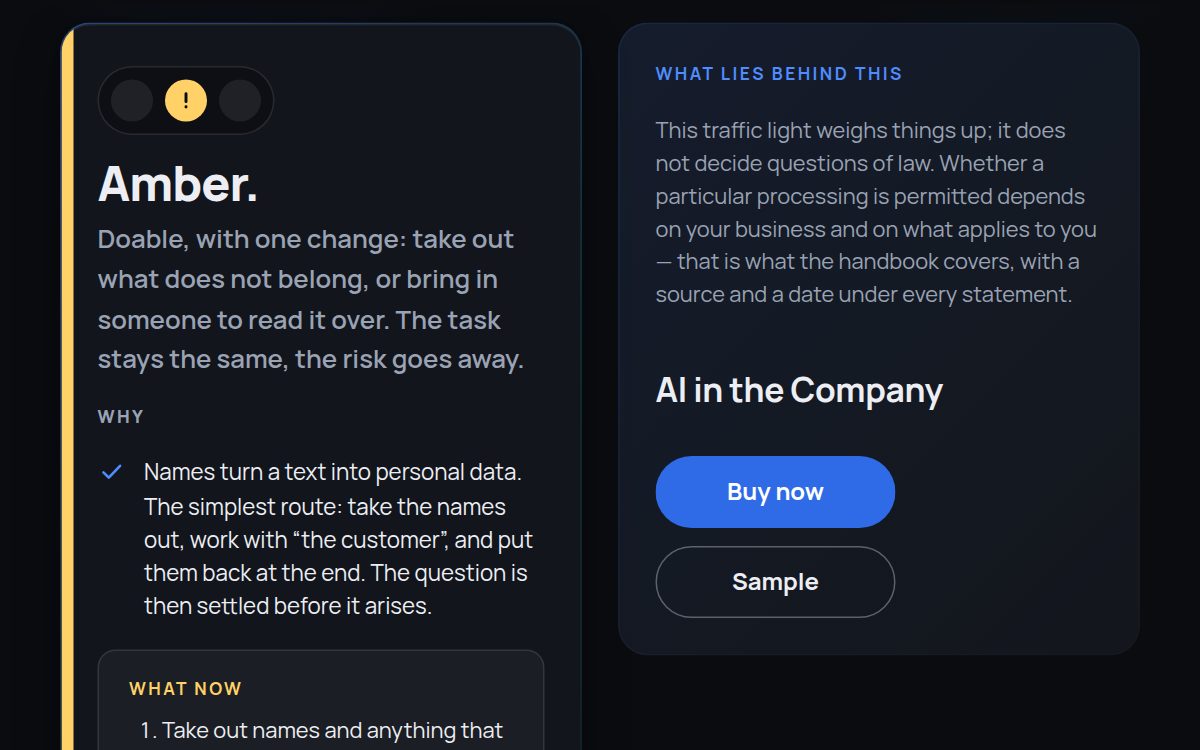
Can this go in?
Three questions about the task, then green, amber or red with reasons.
1 min · freeOpen the traffic light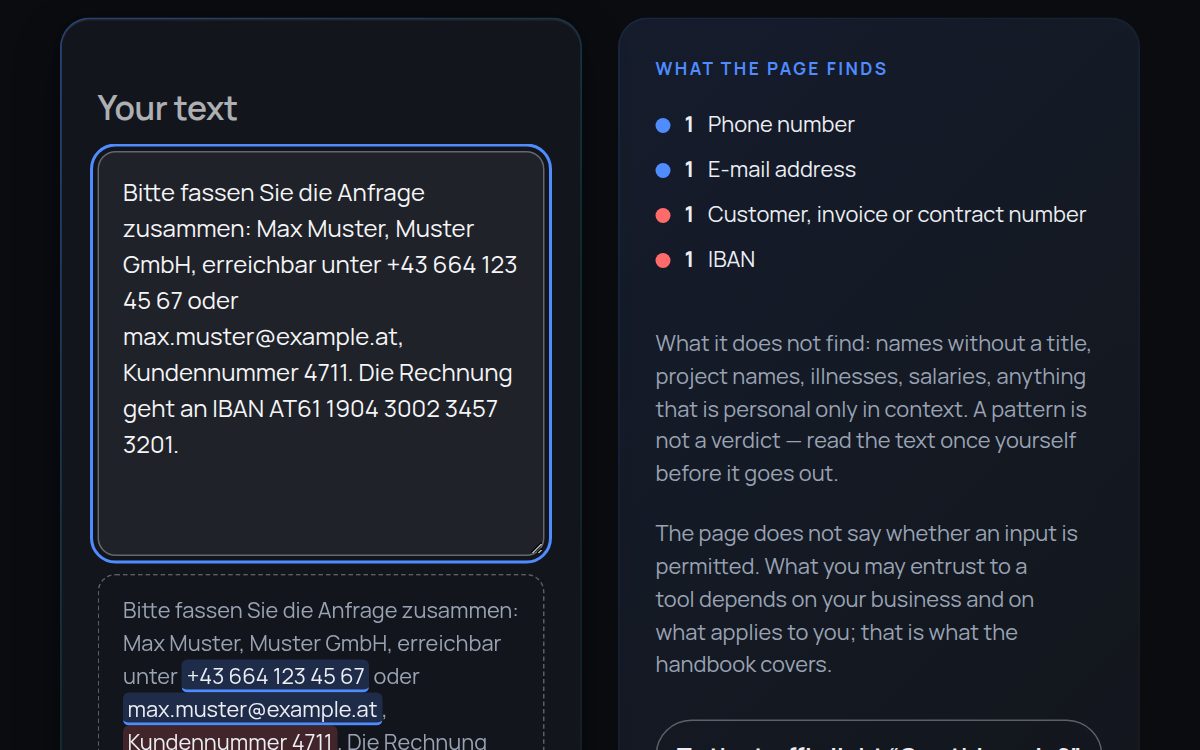
Is there anything personal in here?
Paste text; names and numbers get flagged. In your browser, nothing is sent.
1 min · freeCheck a text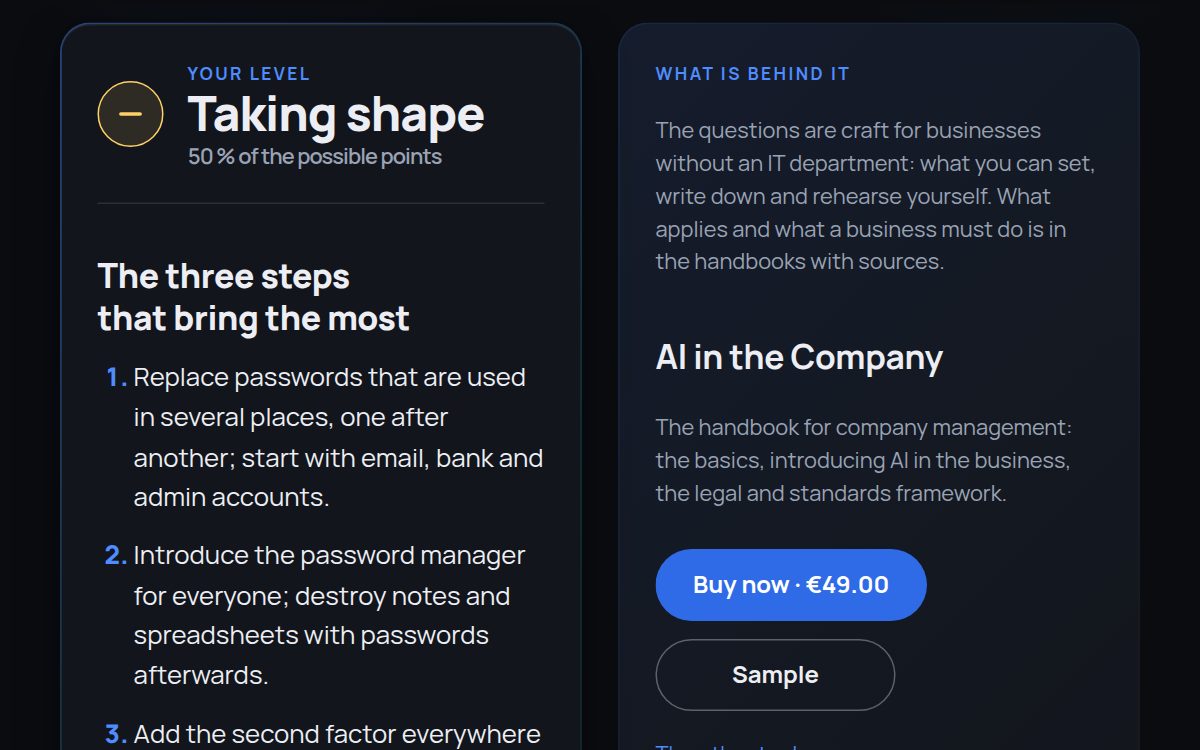
How secure is our sign-in?
Eight questions on passwords and second factor, then three steps.
3 min · freeStart the check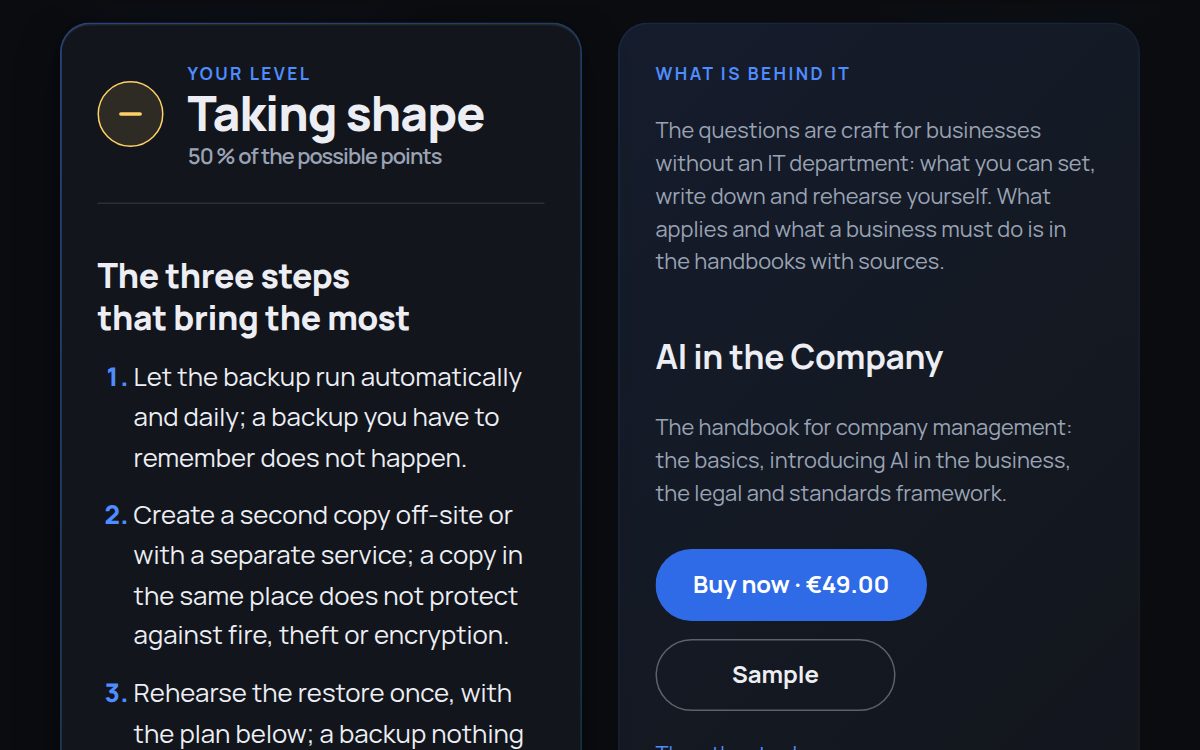
What would be gone tomorrow?
Six questions on backups, then a rehearsal plan to print.
3 min · freeStart the checkFind your bearings and secure for free, prepare with Premium. Nothing is stored without an account.All tools ›
Questions and purchase
What you want to know before buying, and the back cover of the book with the price.
Volume 1 · Back cover
AI in the Company
The handbook for company management: the basics, introducing AI in the business, the legal and standards framework.
PDF · Online reading access · Updates to this edition · Invoice by email
Payment via Stripe. Access and invoice arrive by email straight afterwards.
Is this legal advice?
No. AI in the Company is a handbook: general information, put in context and backed by sources. It does not replace an examination of your individual case and contains no mandatory documents.
What exactly do I get?
The complete handbook as a PDF for download and as online reading access via a personal link: 19 sections in 4 parts, the last part is the appendix with 5 sections. The invoice arrives by email.
What happens if something changes?
Updates within this edition appear in the online access, and the PDF is renewed with your next download.
Who is the handbook not intended for?
For manufacturers who develop AI systems themselves, and for businesses with their own legal or IT security department. It is written for company management who obtain ready-made tools, put them to use and answer for them.
How quickly do I have access?
Immediately after payment. The access link arrives by email and can be requested again at any time.
For you if
- You run a business, from a one-person company to a medium-sized business, without an IT department of your own.
- Your business uses generally available AI tools, or wants to.
- You want to know what is backed by sources, what is open, and what you do now.
How the content is made and who is behind it: About Scutoria.